In modern warehouses, automation is no longer optional-it's a competitive necessity. From AGVs to autonomous forklifts, knowing the precise location of every moving asset is critical. This is where Visual SLAM is changing the game.
What is Visual SLAM?
Visual SLAM (Simultaneous Localization and Mapping) is a technology that enables machines to understand their environment and determine their position at the same time.
Unlike traditional positioning systems such as UWB or LiDAR-based infrastructure, Visual SLAM does not rely on external anchors, reflectors, or markers. Instead, it uses onboard cameras and algorithms to:
· Capture real-time visual data
· Build a dynamic map of the environment
· Continuously calculate its own position
In simple terms, Visual SLAM acts as both the eyes and brain of an autonomous system.
How Does Visual SLAM Work?
A Visual SLAM system typically combines:
· Cameras (for environmental perception)
· IMU (Inertial Measurement Unit)
· Encoder data
Through multi-sensor fusion, the system can maintain stable positioning even in dynamic environments with moving objects.
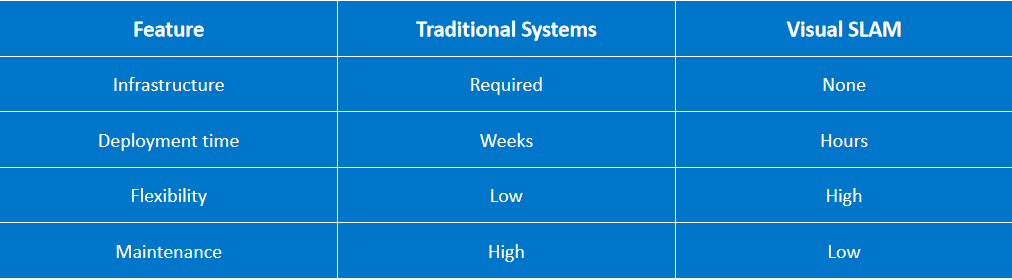
Visual SLAM vs Traditional Positioning
Traditional systems often require heavy infrastructure:
· UWB → anchors installation
· Laser → reflectors setup
· Magnetic → floor modification
Visual SLAM removes these dependencies entirely.
Why Visual SLAM Matters for Warehouses
For logistics operators, this means:
· Faster deployment of automation systems
· Lower upfront investment
· Greater adaptability to layout changes
As warehouses become more dynamic, infrastructure-free positioning is becoming the new standard.
Conclusion
Visual SLAM is not just another positioning technology-it represents a shift toward more flexible, scalable, and intelligent warehouse operations.



Comment
(0)